Medicaid Coverage for Allergy Testing and Immunotherapy by State
Testing is covered nationwide, but treatment access depends on where you live.
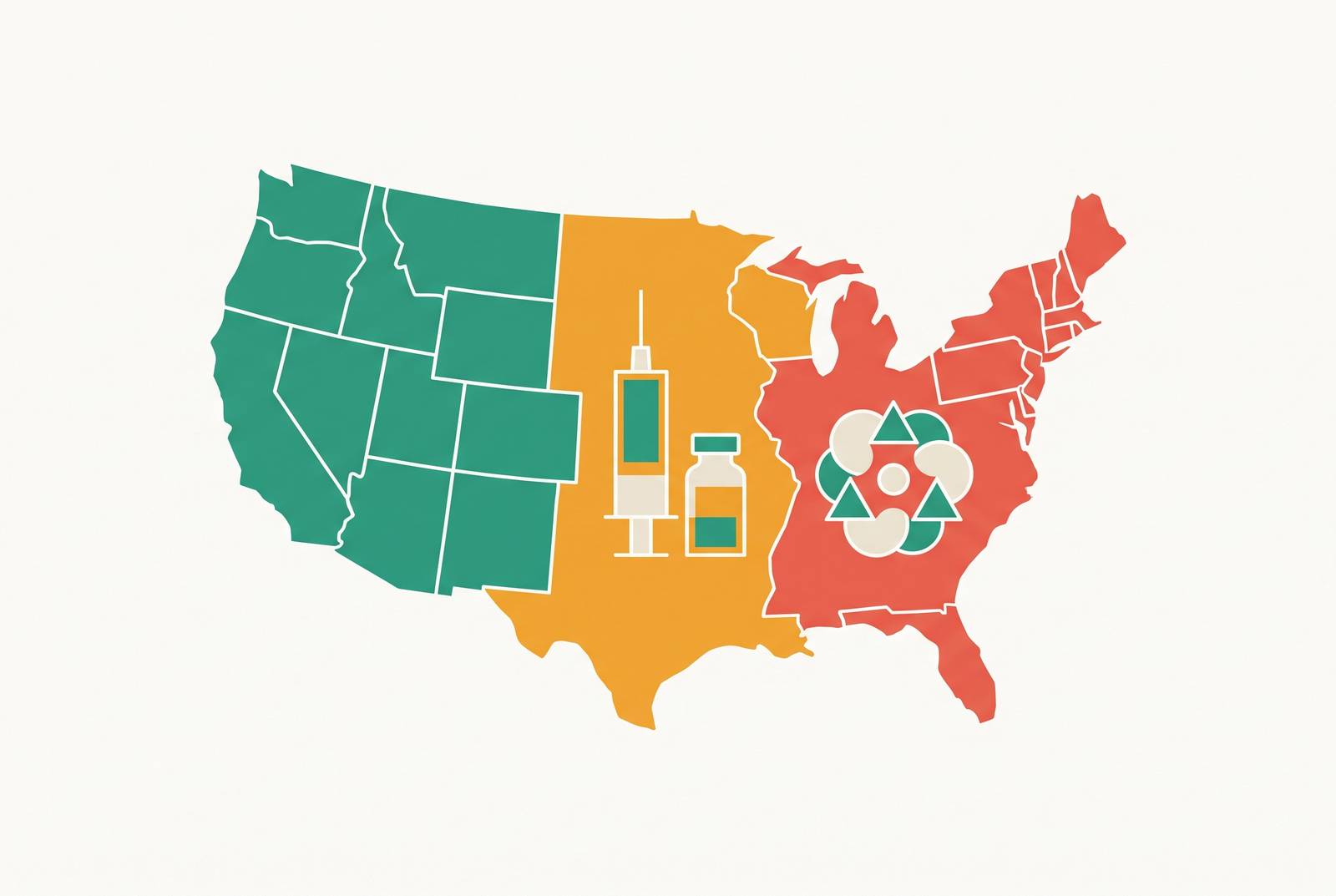
Medicaid guarantees allergy testing in all 50 states, but whether that patient can actually treat the allergy, rather than just name it, depends on which state they live in. Immunotherapy, the only treatment that retrains the immune system instead of masking symptoms, is classified as optional, and states decide for themselves whether to pay for it.
Testing versus treatment: where Medicaid allergy coverage splits
Title XIX of the Social Security Act says every state has to cover physician services and lab services. Allergy testing sits squarely in both categories, so it gets covered everywhere without exception. Specific IgE blood tests (billed under CPT codes 86003 and 86005) and skin prick or intradermal tests (CPT codes 95004 and 95024) are paid for in all 50 states, no carve-outs, no state-by-state debate.
Immunotherapy doesn't get that same guarantee. Allergy shots and sublingual tablets both fall into Medicaid's optional benefit category, so each state can choose whether to include them. A Medicaid patient anywhere in the country can walk out of an appointment knowing what they're allergic to. Whether they can do anything about it beyond buying antihistamines depends on a policy decision made in their state capital, not on their diagnosis.
Managed care as a second layer of variation
If a state covers immunotherapy on paper, that doesn't settle the question for most Medicaid patients. More than 70% of Medicaid beneficiaries are enrolled in managed care organizations, not traditional fee-for-service Medicaid, and MCOs run their own formularies, their own prior authorization rules, and their own provider networks layered on top of whatever the state allows. An MCO can simply leave a drug or service off its formulary even when the state's base Medicaid program covers it. SLIT tablet coverage that looks solid in a state policy document can disappear the moment a specific MCO's rules come into play.
Prior authorization adds another checkpoint. Many plans need a referral from a primary care provider before they approve an allergist visit, and that adds time and paperwork before treatment can even start. Transportation compounds the problem specifically for shots: allergy shots need weekly or biweekly clinic visits for years, and a Medicaid patient without reliable transportation can lose access to a treatment that's technically covered, simply because getting to the clinic every week isn't realistic.
None of this means the system is a dead end. It means checking the state Medicaid policy is a necessary first step but not the last one. A patient also needs to check their specific MCO's formulary and prior authorization requirements, since that's where coverage on paper and coverage in practice tend to part ways.
What the shot-versus-tablet-versus-drops distinction means for Medicaid patients
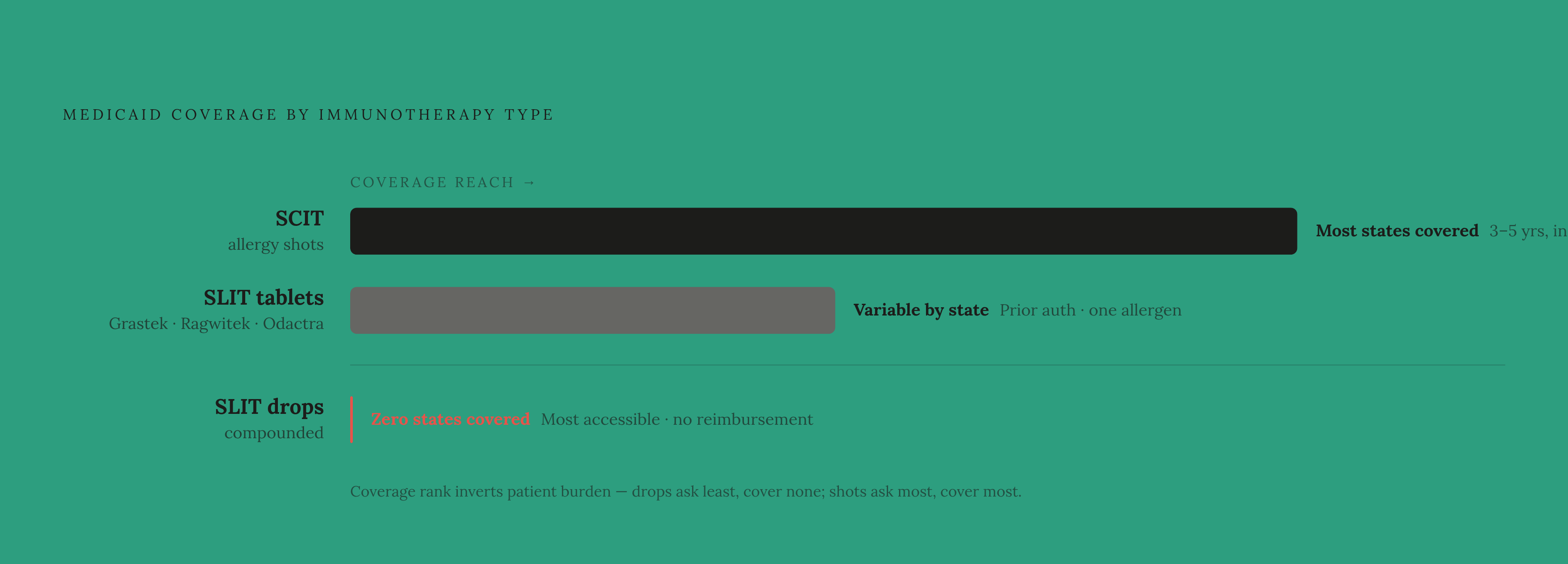
Three forms of immunotherapy exist, and Medicaid treats them very differently. SCIT, the clinical name for allergy shots, is billed under CPT codes 95115 through 95117 for administration and 95144 through 95170 for antigen preparation, and most state Medicaid programs cover it as a physician-administered treatment. Shots are the immunotherapy option most likely to get reimbursed, but they ask the most of a patient's schedule: three to five years of in-clinic visits.
FDA-approved sublingual tablets sit in a murkier spot. Grastek (for timothy grass), Ragwitek (for ragweed), and Odactra (for dust mites) get variable coverage from state to state, usually through the pharmacy benefit rather than the medical benefit, with prior authorization the norm. Each tablet only treats one allergen, so a patient allergic to grass, dust mites, and tree pollen would need separate approvals for separate products, not one blanket prescription.
Custom compounded SLIT drops don't get covered by any state Medicaid program; they're classified as compounded medications rather than FDA-approved products, which keeps them out of formulary review no matter how strong the clinical evidence behind them is. That's a real gap, because drops treat multiple allergens in a single personalized formula and require no clinic visits at all, making them the most practical option for patients dealing with transportation or scheduling barriers. The self-pay cost can be offset by FSA and HSA funds for patients who have access to those accounts. The treatment that asks the most of a patient's time (shots) is the one Medicaid covers most reliably. The treatment that asks the least (drops) is the one Medicaid won't touch in any state.
North Carolina's updated policy as a model for how coverage rules work
North Carolina revised its allergy immunotherapy coverage policy in February 2025, and the update is a useful lens for understanding how these policies function anywhere. NC Medicaid Clinical Coverage Policy No. 1N-2, amended February 1, 2025, covers immunotherapy when the hypersensitivity can't be managed through medication or allergen avoidance alone, and when the triggering allergens have been confirmed through appropriate skin or blood testing.
Coverage doesn't run indefinitely. If the patient hasn't shown a noticeable decrease in symptoms, hasn't developed increased tolerance, hasn't reduced medication use, or has no documented clinical benefit on record, treatment beyond two years stops being covered. Coverage in North Carolina is tied directly to proof the treatment is working.
One feature stands out as unusually patient-friendly: North Carolina's updated policy requires no prior authorization for immunotherapy, a step many states still demand before treatment can begin. Testing is handled under a separate policy, NC Medicaid Clinical Coverage Policy No. 1N-1, also amended February 1, 2025, which covers both in-vivo skin testing and in-vitro IgE blood testing for eligible beneficiaries.
Children also get an added layer of protection through EPSDT, the Early and Periodic Screening, Diagnostic, and Treatment provision. Beneficiaries under 21 may qualify for exceptions to the standard policy limits, a federal requirement that applies in every state, not just North Carolina, and one that often gives kids broader access than adults get under the same program. North Carolina's policy shows what to look for anywhere: a medical necessity threshold, a duration limit, a prior authorization rule (or the absence of one), and whether EPSDT expands the picture for kids.
Florida's dose-based reimbursement structure as a different kind of limit
Florida takes a different approach. Instead of asking whether a patient is improving, Florida Medicaid counts doses and caps coverage there. Florida Medicaid covers allergy services including in vitro specific IgE tests, intracutaneous and percutaneous skin tests, ingestion challenge testing, and allergen immunotherapy itself. But for certain procedure codes, the state reimburses only up to 156 doses every 366 days per recipient for codes 95144 and 95165, and up to 52 doses every 366 days for codes 95145 through 95149 and 95170.
That's a fundamentally different question than the one North Carolina asks. North Carolina's policy checks on clinical progress: is the patient getting better? Florida's policy checks a counter: how many doses has this patient already received this year? Both are legitimate ways to manage a program, but they create opposite risks for patients. Someone near their annual dose cap in Florida hits a coverage cliff regardless of whether the treatment is actually working for them. Someone in North Carolina hits a coverage cliff only if the treatment isn't working. Both states cover the underlying service. What separates them is the architecture of the limit, which a patient starting a multi-year treatment course needs to understand before they commit to it.
The Broader State Landscape
North Carolina and Florida sit at two points on a spectrum that runs from comprehensive coverage to coverage that barely exists in practice, and the variables that determine where a given state falls tend to repeat across the country. Allergy shots get covered by most state Medicaid programs as a physician-administered treatment. SLIT tablet coverage keeps growing as more products earn FDA approval, but it's still inconsistent from state to state. Custom drops stay excluded everywhere, with no exceptions on record.
New York and other states with larger, more built-out Medicaid programs tend to offer more expansive allergy coverage across testing and medication alike. Coverage on paper doesn't always translate into coverage in practice, though. Nevada has been noted as a state where services are nominally covered but access is limited because too few specialists in the state's provider network accept Medicaid patients.
One lever cuts across every state: EPSDT. Federal law says every state Medicaid program has to provide any medically necessary, Medicaid-coverable service to a child under 21, even if that state doesn't cover the service for adults. A child in a state that excludes immunotherapy for grown-ups may still qualify for it simply because of their age.
You should also check telehealth before booking an appointment. Every state expanded Medicaid telehealth coverage during the COVID-19 public health emergency, and most have since made those expansions permanent or semi-permanent. Reimbursement rates, which provider types qualify, and which services are covered through telehealth still differ by state, so you should confirm the current telehealth policy before you schedule a virtual allergy consultation. Anyone trying to map their own state's position should look up five things: whether the state covers SCIT as a Medicaid benefit, whether the formulary includes any FDA-approved SLIT tablets, whether the patient's MCO adds its own restrictions, whether prior authorization is required, and whether EPSDT applies because the patient is under 21.
Medicare Part B covers allergy tests and immunotherapy when medically necessary, with beneficiaries paying a 20% copay after their deductible, while Part D covers prescription allergy medications. A new Local Coverage Determination for Allergy Diagnostic Testing has also been introduced, issued by individual Medicare Administrative Contractors for their own jurisdictions.
The contrast is hard to miss. Medicare serves an older population that's generally less mobile, and it's moving to expand immunotherapy access. Medicaid serves children, working adults, and people managing mobility constraints of their own, and in many states its coverage structure hasn't moved in years. This isn't a suggestion that anyone switch programs; it's a policy observation: coverage of immunotherapy is a deliberate choice, and Medicaid's fragmentation across states reflects decisions states are actively making, not some fixed ceiling built into the program itself.
Untreated Allergies as a Compounding Problem
For a Medicaid patient whose state excludes immunotherapy or whose MCO won't reimburse it, the default alternative is indefinite symptom management, and untreated allergies carry costs that antihistamines and nasal sprays simply don't touch. Chronic nasal congestion pushes people into mouth breathing, especially during sleep, and that pattern can worsen snoring and contribute to sleep-disordered breathing, including sleep apnea, a chain that starts with inflammation nobody's treating.
Children carry a distinct version of this burden. Congestion, fatigue, and disrupted sleep interfere with concentration, memory consolidation, and emotional regulation, which affects school performance. This is why the EPSDT provision discussed earlier matters so much for kids: a treatment path that's closed off to adults in a given state may still be open to a child under 21, and the stakes for that child are not trivial.
Chronic inflammation from unmanaged allergies is also linked to sustained mood disruption. People living with uncontrolled allergies report more irritability, more trouble concentrating, and symptoms that overlap with mild anxiety and depression. Antihistamines only address symptoms temporarily, and older antihistamines carry sedation effects that can impair cognitive function in their own right. Nasal decongestant sprays carry rebound risk with continued use. These options leave the underlying immune response driving the allergy unchanged. If a Medicaid patient's coverage doesn't reach immunotherapy, they end up on indefinite medication that manages symptoms at best and adds its own side effects on top.
Clinical Evidence on Sublingual Immunotherapy for Patients Weighing Their Options
For patients considering self-pay SLIT because their Medicaid plan won't cover it, the clinical evidence behind the treatment is substantial. Randomized controlled trials support clinically meaningful reductions in both symptoms and medication use with grass and house dust mite SLIT tablets, and the benefits don't vanish the moment treatment ends. Sustained improvement has been observed for one to two years after a three-year treatment course.
Real-world cohort data add something trials alone can't capture: a reduced risk of new asthma onset and lower long-term medication use following SLIT. A five-year surveillance study published in 2025 tracked children with allergic rhinitis and atopic cough through a three-year SLIT course, and their symptom improvements held even after treatment stopped, with the data running through 2024.
Allergen immunotherapy holds a distinction no antihistamine or nasal spray can claim: it's the only treatment with the potential to modify the disease process behind IgE-mediated respiratory allergy, rather than just suppressing symptoms while it's being taken. Stop an antihistamine and the symptoms come right back. Immunotherapy aims at something more durable than that.
The safety profile supports home use. No fatalities have been reported with SLIT, and severe systemic reactions are rare, which matters for a treatment patients administer themselves without a clinician standing over them. The evidence isn't uniform across every outcome, though. SLIT's effect on day-to-day asthma control is less consistent than its effect on rhinitis symptoms, and for some allergens, subcutaneous immunotherapy, meaning shots, still has a stronger evidence base behind it than the sublingual route does. Patients weighing their options should know both sides of that picture.
Navigating the Coverage Gap as a Medicaid Patient Seeking Immunotherapy
Knowing where a state stands on immunotherapy coverage is the starting point, not the finish line, and getting to lasting relief takes a specific sequence of steps.
The first step is getting tested, since allergy testing is guaranteed under Medicaid in every state regardless of what happens with treatment coverage later. A specific IgE blood test ordered through a Medicaid-enrolled provider, or a skin prick test, identifies the allergens actually driving the symptoms, and that result is the foundation any treatment plan has to build on. For patients who want results before a Medicaid appointment, or who want a more detailed allergen panel than their provider offers, at-home finger-prick testing is also available through telehealth providers.
The second step is checking the state's specific immunotherapy coverage policy. North Carolina's 1N-2 policy, described earlier, is a useful model for what to look for: whether shots or SLIT tablets are covered, what prior authorization is required, and whether duration limits apply.
The third step is checking the rules of the specific managed care plan a patient is enrolled in, separately from the state policy. Requesting the MCO's formulary and prior authorization criteria directly matters because the MCO layer is exactly where coverage that looks solid on paper tends to disappear in practice.
The fourth step applies to anyone under 21: ask explicitly about EPSDT eligibility. Federal law may entitle a child to immunotherapy even in a state that doesn't cover it for adults, and that eligibility doesn't get offered automatically. It has to be asked about.
The fifth step is for patients whose Medicaid coverage simply doesn't reach immunotherapy no matter how the first four steps shake out: exploring self-pay sublingual immunotherapy. Custom compounded SLIT drops aren't covered by any state Medicaid program, but they're available as a self-pay option, and FSA or HSA funds can be applied toward the cost where a patient has access to those accounts. Wyndly runs a telehealth model built for exactly this situation: a virtual consultation priced at $49.99, personalized at-home allergy testing, and a customized sublingual immunotherapy plan shipped to the patient's door, with treatment plans starting at $99 a month. It's a doctor-guided path to root-cause treatment that requires no in-person clinic visit, making it a particularly workable option for Medicaid patients who've run into the transportation or scheduling barriers that make a multi-year shot program difficult to sustain.
Sources
- NC Medicaid Medicaid Allergy Testing Clinical Coverage Policy No: 1N-1
- NC Medicaid Medicaid Allergy Immunotherapy Clinical Coverage Policy No: 1N-2
- Allergy Services
- Clinical efficacy of sublingual immunotherapy for allergic rhinitis and atopic cough: 5-year real-world surveillance - ScienceDirect
- LCD - Allergy Testing (L36402)